
The Internet Plans More Seniors Are Switching To In 2026
Prices keep changing, promos expire, and the fine print got trickier. Seniors often want steady service for calls, streaming, and telehealth without surprise fees. This article is for anyone helping an older adult switch plans, or checking if their current bill still makes sense.
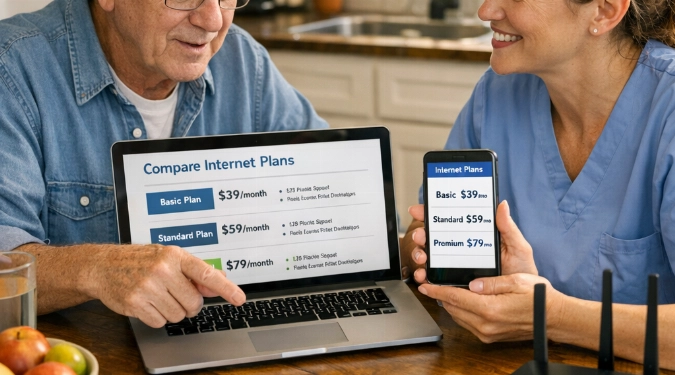
Pick the right plan by matching speed, data, and price to what you actually do online. This guide shows the plan types seniors are switching to in 2026, plus real price ranges. You’ll get a fast checklist to compare offers, dodge fees, and ask for the right discounts.
The Six Plan Types Winning In 2026
1) Fixed Wireless Home Internet
This is home internet delivered from a nearby tower to a small modem. It is popular where cable prices jumped or service is unreliable. Typical pricing runs $40 to $65 per month with autopay. Watch for speed swings at busy hours.
Common providers include T-Mobile Home Internet, Verizon 5G Home, and AT&T Internet Air. Ask if your address qualifies for the “best effort” tier or a higher priority tier. Also ask about equipment fees, since some plans include the gateway.
2) Fiber 300 Plans
Seniors who want stability often land on entry fiber. The sweet spot is usually 300 Mbps. It handles video calls, streaming, and smart devices without tweaking anything. Expect $45 to $75 per month, depending on promos and router rental.
Brands you may see include AT&T Fiber, Verizon Fios, Google Fiber, and Frontier Fiber. Ask for the standard rate after the promo ends. Also ask if the plan includes unlimited data by default.
3) Prepaid Cable Internet
Prepaid plans remove contracts and some surprise fees. They can be easier for fixed incomes. Speeds vary, but many land in the 50 to 200 Mbps range. Pricing is often $30 to $55 per month.
Look for options from Xfinity Prepaid and Spectrum Internet Assist style offers. Availability is address-based. Confirm modem ownership rules before you sign up.
4) Low-Income Discount Plans
These plans are switching magnets because they cut the bill without changing daily habits. They are usually 50 to 100 Mbps. Pricing often lands at $10 to $30 per month. Eligibility depends on specific benefit programs or income rules.
Ask the provider for their “internet essentials” style product. Also ask what proof they accept. Some accept benefit award letters or enrollment confirmations.
5) Mobile Hotspot As Primary Internet
Some seniors are dropping home internet entirely. They use a phone hotspot or a dedicated hotspot device. This works best for light streaming and browsing. It can be $25 to $60 per month, but data limits matter.
Ask for the hotspot data cap and video throttling policy. Also ask if the plan allows a standalone hotspot line. Brands to check include Cricket, Visible, Metro, and Mint Mobile.
6) Satellite With Newer Hardware Tiers
Satellite is still a last resort for many, but it is improving. It can be the only practical choice in remote areas. Expect $90 to $140 per month, plus hardware that can run $250 to $600. Latency is still higher than wired options.
Starlink is the name most people know. Hughesnet and Viasat are also common. Ask about data priority policies and typical evening speeds.
The 10-Minute Comparison Checklist
- Pick a speed target. 100 to 300 Mbps fits most homes with streaming and video calls.
- Confirm the real monthly price after promos. Write down month 1 and month 13 pricing.
- Ask about data caps. If there is a cap, ask the overage cost or throttled speed.
- List one-time charges. Installation, activation, and shipping add up fast.
- Check equipment terms. Ask if the router is included, rented, or optional.
- Ask about autopay requirements. Many “$50” plans are $55 without it.
- Confirm contract terms. Look for no contract or a clear early termination fee.
- Run a real coverage check for fixed wireless. Ask for expected indoor signal strength.
- Ask for a 14-day trial or grace period policy. Many providers have one.
- Get the offer in writing. Ask for an order summary email before you agree.
Where Seniors Are Finding Better Deals
Start with the provider’s “plans” page and the “offers” page. Those pages often differ. Then call retention and say you are comparing fiber, fixed wireless, and prepaid. Ask what they can do to keep your account.
Also check if your building has a bulk agreement. Some apartments include a discounted plan with an option to upgrade. Ask the property manager, not just the provider.
Fees That Surprise People In 2026
Router rental is the big one. It can be $10 to $15 per month. Over a year, that is $120 to $180. Ask if you can use your own router, and ask for the compatibility list.
Another gotcha is “included” streaming bundles that later auto-bill. Ask what subscriptions are free only for a few months. Put the end date on a calendar.
FAQs That Change The Decision
Is 1 Gbps worth paying for?
Usually not for one or two people. The upgrade helps with large downloads and many active devices. It rarely improves video call quality. Stability and Wi-Fi coverage matter more.
What should I ask for if Wi-Fi is weak in one room?
Ask if the provider supports mesh Wi-Fi kits. Also ask if they charge monthly per extender. Compare that to buying a mesh kit once from brands like eero or TP-Link.
How do I test speed the right way?
Test on a laptop with an Ethernet cable if possible. Run three tests in the morning and three at night. Write down both download speed and upload speed. Upload matters for video calls.
Can I keep my landline phone?
Often yes, but it changes the bill. Ask about VoIP home phone add-ons. Also ask if your medical alert system needs a traditional phone jack.
References
- Federal Communications Commission (FCC)
- Provider plan pages: T-Mobile, Verizon, AT&T, Xfinity, Spectrum, Starlink, Hughesnet, Viasat
Disclaimer: The information provided in this article is for educational and informational purposes only. It does not constitute professional advice. Readers should conduct their own research and consult with qualified professionals before making any decisions.