
The AI Gold Rush: 7 Skills That Will Make You Irreplaceable in 2026
Everyone says to “learn AI,” but job posts rarely explain what makes someone safe from automation. You might be in ops, product, design, or engineering. You want a short list of skills that map to real work and a way to prove them to employers, without chasing every new model release.
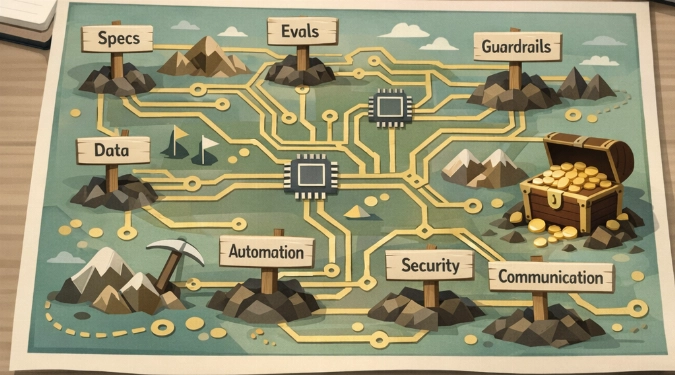
You’ll learn seven skills that keep you valuable even as models improve. This guide shows what to practice, what tools to use, and what projects prove you can do the work. You will also get a 30-day plan you can start this week, with clear checkpoints.
Skill 1: Turn Messy Work Into Clear Specs
AI output is only as good as the brief. Teams pay for people who can turn vague needs into testable requirements.
Practice writing one-page specs. Use a format with goal, non-goals, users, data inputs, and success metrics. Add acceptance tests that a non-expert can verify.
Tools to learn: Notion, Confluence, Jira, Linear, Miro, Lucidchart. Ship one spec per week. Ask a friend to “break” it with edge cases.
Skill 2: Evaluate Models Like A Product, Not A Demo
In 2026, “it seems good” will not be enough. You will need evals that catch drift, bias, and silent failures.
Build a small eval harness. Start with 50 real examples and a scoring rubric. Track pass rate and reasons for failure.
Learn these tools: LangSmith, Weights & Biases, Arize Phoenix, Ragas, OpenAI Evals. Add a simple canary set for regression tests.
Skill 3: Ship AI Features With Guardrails
Useful systems need constraints. Guardrails reduce hallucinations, data leaks, and policy violations.
Learn patterns that show up in production. Use retrieval for grounded answers, and tool calling for actions. Add caching, rate limits, and fallbacks.
Frameworks worth knowing: LangChain, LlamaIndex, PydanticAI, OpenAI Agents SDK, Haystack, Vercel AI SDK. Build a demo that logs prompts and outputs.
Skill 4: Data Literacy For Small Teams
Most AI projects fail from data issues, not model choice. The irreplaceable person can audit data fast.
Know how to spot label noise, leakage, and skew. Create a data card with source, consent, retention, and known gaps. Track dataset versions the same way you track code.
Practice with SQL and one warehouse tool. Use BigQuery, Snowflake, or Postgres. Add dbt for transforms and Great Expectations for checks.
Skill 5: Automate Workflows With Code And No-Code
Teams want automation that survives handoff. You need enough code to own the last mile.
Learn Python for glue code and TypeScript for web hooks. Pair them with tools like Zapier, Make, n8n, Retool, and Airtable. Build one workflow that saves a real hour weekly.
Good portfolio projects include invoice triage, support tagging, or meeting-note extraction with approvals. Add human review steps where errors hurt.
Skill 6: Security And Privacy Basics For AI
AI work touches sensitive data. You become valuable when you can ship safely without slowing the team.
Learn threat models for prompts and tools. Know prompt injection, data exfiltration, and secrets handling. Use least privilege for connectors and rotate keys.
Know the basics of OWASP Top 10 and OWASP LLM Top 10. Practice red teaming with a checklist and documented fixes. Keep audit logs for inputs, tools used, and outputs.
Skill 7: Communicate Tradeoffs To Non-Technical Leaders
AI decisions are full of tradeoffs. Leaders need clear options, not jargon.
Use a simple template: options, cost, risk, expected quality, and timeline. Translate metrics into outcomes like fewer tickets or faster onboarding. Write short memos that stand alone.
Practice live demos with failure cases. Show what breaks, why it breaks, and what the guardrail does. That builds trust faster than perfect slides.
A 30-Day Plan You Can Follow
Week 1: Pick A Target Workflow
Choose one job task you can access end to end. Write a one-page spec. Collect 30 to 50 real examples.
Week 2: Build And Measure
Build a prototype with logging. Create an eval set and scoring. Record baseline performance and top failure modes.
Week 3: Add Guardrails And Data Docs
Add retrieval or tool calling. Add red team tests and fixes. Write a data card and a short risk note.
Week 4: Package Your Proof
Publish a README with screenshots and metrics. Include a two-minute demo video. Write a memo that explains tradeoffs and next steps.
How To Prove These Skills In Interviews
Bring artifacts, not claims. Show a spec, an eval report, and a guardrail design.
Tell a story with numbers. Example: “Pass rate improved from 62% to 84% after retrieval and a stricter rubric.” Keep the dataset small and explainable.
FAQ
What If I Am Not A Developer?
Start with specs, eval rubrics, and workflow mapping. Pair with Retool or Zapier for prototypes. Add light Python later for reliability.
Which Certifications Help The Most?
Pick credentials that match your target role. Useful options include AWS Certified Machine Learning, Google Professional Data Engineer, and Microsoft AI-102. Treat them as structure, not proof.
How Do I Choose Between AI Jobs And A Traditional Role?
Choose based on access to data and shipping cycles. Roles with weekly releases build skill fastest. Ask who owns evals, logging, and incidents.
Disclaimer: The information provided in this article is for educational and informational purposes only. It does not constitute professional advice. Readers should conduct their own research and consult with qualified professionals before making any decisions.