
Step Into 1950s High School Classrooms Historically
Movies love the 1950s, but sets often get the classroom wrong. If you are restoring a room, building a display, or just curious, the details matter. Desks, tech, rules, and teen life all changed fast in one decade. This article walkthrough helps you separate real period cues from retro myths.
You’ll be able to spot the real classroom details people miss. You’ll learn what a period room sounded like, smelled like, and ran on. You’ll also get a checklist for building a believable setup at home or for a display, without buying random “vintage” stuff.
What You’d Notice First
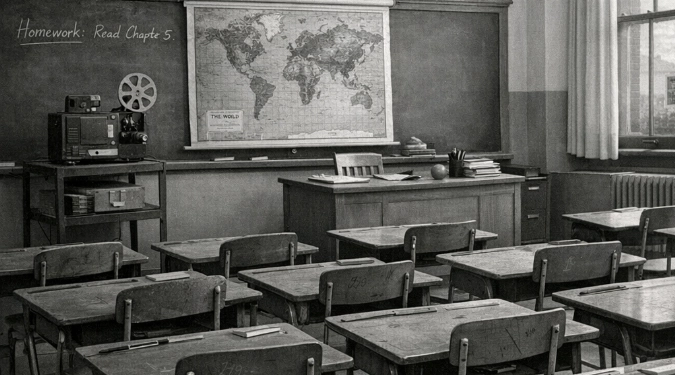
The room felt orderly, and a little crowded. Rows faced the teacher’s desk. Light came from tall windows and harsh fluorescents. The air carried chalk dust, floor wax, and wool coats. The centerpiece was the school desk. Many rooms mixed sizes. Some were fixed to the floor, and some were movable. In older buildings you still saw old fashioned school desks, with ink wells and cast iron legs.
The Desk Itself Was A Tool
A classic school desk usually had a solid wood top. Many had a groove for pencils. Some had a lift-up lid with storage inside. Others used an open wire rack underneath. A wooden school desk was not just furniture. It controlled posture and spacing. It also controlled sightlines. Teachers could scan notebooks fast. Students had limited room to fidget. Gum, carving, and pen scratches were common.
What Sat At The Front Of The Room
The teacher’s desk was a command station. It held grade books, a hall pass, and a box of chalk. A bell or buzzer handled class changes in many schools. Behind it was the chalkboard. Many rooms had a pull-down map. Common brands included Rand McNally, Denoyer-Geppert, and Hammond. A flag stood in a corner. A wall clock kept everyone honest.
1950s Classroom Technology Was Simple
S classroom technology was mostly analog and shared. A filmstrip projector was a big deal. So was a 16mm film projector for assemblies or special lessons. Common machines included Bell and Howell projectors, Kodak Carousel slide gear in some schools, and Wollensak tape recorders for language practice. Overhead projectors existed, but they were not everywhere yet. If the intercom worked, it mattered. Morning announcements tied the building together. Fire drills and air-raid drills also shaped routines.
What Teen Culture Looked Like In School
Dress codes were real, and social lines were visible. Letterman jackets and club pins signaled status. Girls’ skirts and sweaters followed school rules and local norms. So, why was it that the 1950s produced the phenomenon of the american teen culture? More students stayed in school longer. Many had part-time jobs and spending money. Radio, records, and movies targeted them directly. School became a daily stage for identity.
Home Life Leaked Into The Classroom
Students compared notes on music, cars, and last night’s shows. Families were buying more consumer goods. Suburbs grew fast, and commutes changed time at home. A common question is, by 1959 how many hours of tv a day was the average american family watching. Surveys varied, but estimates often land around three to five hours daily. That changed homework rhythms and dinner conversation.
Prosperity Was Real, But Not Even
People still ask, were the 1950s a time of great peace progress and prosperity for americans. Many families did see rising wages and new appliances. The GI Bill expanded college access for some. Polio vaccines and highway building signaled progress. But prosperity was not shared equally. Many schools were underfunded. Segregation and discrimination shaped who got what. The classroom could feel calm while big conflicts simmered outside.
A Fast Compare: Suburb Choices And Car Choices
Teen life connected to postwar buying. That includes housing patterns and car culture. One way to see it is to ask: how do the new car options differ from the choices of homes in levittown. Car makers pushed annual model changes and flashy options. Levittown homes offered limited models, strict rules, and small variations.
Field Checklist For Museums, Sets, Or Thrift Finds
- Desk: metal frame, worn wood top, simple hardware, period pencil groove.
- Seating: attached chair or separate wood chair with tubular legs.
- Front wall: chalkboard, ledge, erasers, clean board borders.
- Learning aids: pull-down map, globe, cursive chart, periodic table later in the decade.
- Tech cart: filmstrip projector, screen, extension cord, record player if fitting.
- Ambient cues: radiators, tall windows, institutional paint, scuffed baseboards.
FAQ
How Was Life In America In The 1980s Different From That Of The 1970s?
The 1980s saw more home computers and cable TV. Schools added computer labs and newer media carts. The 1970s had more open classrooms in some districts. The 1980s leaned back toward structure.
What Paint Colors Read Most Accurate?
Aim for off-white walls and darker trim. Use muted greens and browns on boards and furniture. Avoid bright modern whites. Avoid saturated accent walls.
How Do You Spot A Reproduction Desk?
Check fasteners and finishes. New welds look too clean. Modern poly finishes look glassy. Real wear is uneven and layered.
References
- Library of Congress: school photographs and classroom ephemera collections.
- Smithsonian collections: education artifacts and mid-century material culture.
- National Center for Education Statistics: long-run enrollment trends.
- Television history scholarship and mid-century time-use studies.
Disclaimer: The information provided in this article is for educational and informational purposes only. It does not constitute professional advice. Readers should conduct their own research and consult with qualified professionals before making any decisions.