
Spinal Stenosis Progression in Older Adults: Key Insights
Spinal stenosis progression in older adults is often gradual, showing up first as leg tiredness or heaviness with standing and walking, then evolving into more predictable limits known as neurogenic claudication. This article explains what progression means (imaging changes versus real-life function), why symptoms may ease when leaning forward, and which age-related spine changes commonly drive narrowing. It also outlines how clinicians track progression with exams and MRI, and how treatment typically escalates—from movement-focused rehab and pacing strategies to image-guided injections and, in select cases, decompression surgery. You’ll also learn which later-stage changes warrant faster evaluation and what practical questions to ask when choosing care.
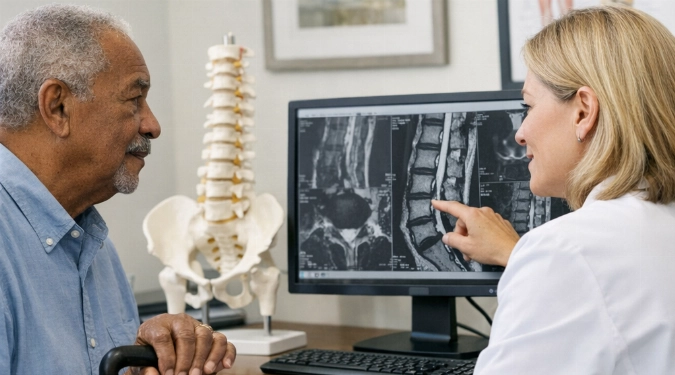
Spinal stenosis rarely changes overnight. In many older adults, it progresses in small, predictable steps—starting with “my legs get tired” and sometimes ending with limits on walking, standing, and confidence. Here are the key insights on how symptoms often appear first, how the condition can develop, and what options are typically used as it advances.
What “Progression” Means In Spinal Stenosis
Spinal stenosis progression refers to the gradual narrowing of spaces in the spine that can crowd nerve roots or the spinal cord. In older adults, the most common drivers are age-related changes like facet joint arthritis, thickening of the ligamentum flavum, and bulging or degenerating discs. In the low back, these changes can reduce room for the cauda equina nerve roots and contribute to leg symptoms when standing or walking.
Progression can describe imaging changes (what an MRI shows) and functional changes (what a person can do). Those two do not always match: some people have significant narrowing on MRI but manageable symptoms, while others have modest narrowing with major limits in daily movement.
How Spinal Stenosis Often Starts And Worsens
Many people notice early symptoms during upright activity because extension (standing tall, walking downhill) can further reduce space around nerves. Over time, repeated irritation may increase pain sensitivity and muscle guarding, which can make walking tolerance shrink even if the anatomy changes slowly.
Common Early Symptoms Doctors Hear First
Early complaints often include leg heaviness, aching in the buttocks or thighs, tingling, or a vague sense of fatigue after standing. A classic pattern is feeling better when leaning forward—over a shopping cart or using a walker—because flexion can temporarily open the canal and foramina.
Mid-Stage Changes That Affect Daily Life
As stenosis progresses, “neurogenic claudication” may become more consistent: symptoms predictably show up after a certain distance and ease with sitting. Some people develop balance changes, reduced stride length, or start avoiding outings because they cannot count on their legs.
Later-Stage Red Flags That Need Prompt Evaluation
Worsening weakness, repeated falls, or new bowel/bladder control problems are not typical “wait and see” issues. These can signal significant nerve compromise and are reasons clinicians often escalate evaluation quickly, sometimes with urgent imaging.
Why Older Adults Progress Differently
Progression is influenced by more than the spinal canal. Osteoporosis-related posture changes, hip or knee arthritis, peripheral neuropathy, and vascular disease can amplify walking limits and mimic or compound stenosis symptoms. Medications, sleep quality, and overall conditioning also shape how quickly stamina declines.
Key Evaluation Tools That Track Progression
Clinicians typically combine a history of walking tolerance with a focused neurologic exam and imaging. MRI is commonly used to assess central canal narrowing and foraminal stenosis, while X-rays can show alignment and instability. In some cases, an EMG/NCS is used to differentiate nerve root irritation from peripheral neuropathy.
Treatment Options As Symptoms Progress
Progression does not automatically mean surgery; many older adults cycle through periods of flare and stability. Options are usually layered from least invasive to more invasive based on function, neurologic findings, and response to prior care.
Movement-Based Care And Physical Therapy
Flexion-biased exercises, hip mobility work, and progressive walking plans are commonly used. Many programs emphasize core endurance, glute strength, and pacing strategies (shorter bouts more often). When people search spinal stenosis physical therapy near me, it helps to ask whether the clinic routinely treats neurogenic claudication and can tailor a home program around walking tolerance.
Medications And Image-Guided Injections
Non-opioid pain relievers may be used for symptom control, and some patients consider image-guided injections. An epidural steroid injection may reduce inflammation around irritated nerve roots for weeks to months, though responses vary and repeat injections are typically limited. If you see the phrase epidural steroid injection for spinal stenosis near me, confirm the setting uses fluoroscopy guidance and tracks functional outcomes like walking distance, not only pain scores.
When Surgery Enters The Conversation
If progressive weakness, severe claudication, or failure of conservative care limits basic mobility, decompression procedures may be discussed. Techniques range from laminectomy to targeted decompression, sometimes with fusion when instability is present. People exploring minimally invasive spinal stenosis surgery near me often ask about incision size, blood loss, time to walking, and whether a fusion is expected based on spondylolisthesis or dynamic instability.
Choosing The Right Clinician As Progression Changes
Because progression can be functional as much as structural, many patients do best with clinicians who measure walking tolerance, neurologic status, and response to each treatment step. If you’re searching spinal stenosis specialist near me, look for someone who can explain the likely pain generator (central canal vs foraminal) and outline a stepwise plan. If symptoms are severe or neurologic deficits are increasing, a spinal stenosis surgeon near me can clarify which decompression approach is typically used and what risks matter most in older adults, such as infection, blood clots, or postoperative delirium.
For people who want nonoperative optimization, asking about lumbar spinal stenosis treatment near me can also include supervised rehab, assistive device fitting, and fall-risk screening—practical supports that often improve independence even when imaging looks unchanged.
FAQs About Spinal Stenosis Progression In Older Adults
Does spinal stenosis always get worse? Not always. Many people have slow changes over years with periods of stability. Progression is often measured by function—how far you can walk, how long you can stand—rather than MRI findings alone.
What symptoms usually appear first? Leg heaviness, aching, tingling, or fatigue with standing and walking are common early signs. Relief with sitting or leaning forward is a frequent clue.
Can exercise make progression worse? Appropriately dosed exercise typically supports mobility and endurance. Overdoing extension-based activities or ignoring escalating neurologic symptoms can aggravate pain, so pacing and form matter.
How long do injections last if they help? Relief varies. Some people feel improvement for a few weeks; others for a few months. Injections are generally used to support rehab and function, not as a permanent fix.
When is surgery considered? Surgery is commonly discussed when walking tolerance becomes severely limited, when conservative care fails to maintain function, or when neurologic deficits (like worsening weakness) appear.
Conclusion
Spinal stenosis progression in older adults often follows a recognizable arc: early leg fatigue with walking, increasing neurogenic claudication, and—sometimes—neurologic changes that require more urgent evaluation. Tracking function, understanding what drives symptoms, and using staged options like targeted therapy, selective injections, and (when needed) decompression can help many people stay safely moving and independent.
Disclaimer: The information provided in this article is for educational and informational purposes only. It does not constitute professional advice. Readers should conduct their own research and consult with qualified professionals before making any decisions.