
Smarter Enterprise Management Systems Explained
Enterprise tools pile up fast, and the seams are where money leaks. Maybe your fleet data lives in three portals, facilities run blind on energy, or ideas die after one meeting. You need a system plan that integrates cleanly, proves value, and rolls out without breaking daily operations.
What an Enterprise Management System Does
An enterprise management system coordinates end-to-end processes through an integrated suite of applications that share a common data model, supporting finance, HR, supply chain, service, and asset operations. This foundation is often described as ERP platforms delivering unified applications across core functions.
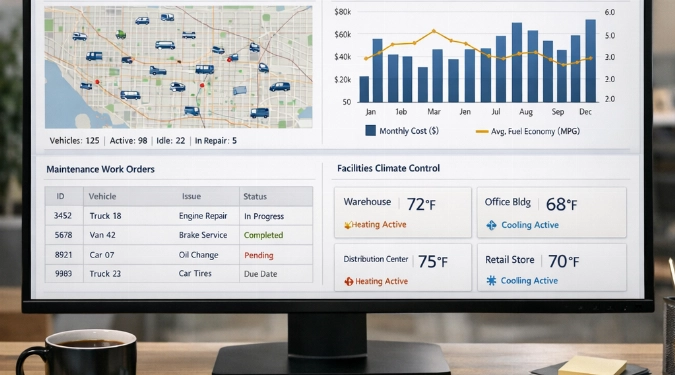
Modern deployments extend beyond a single suite. Organizations combine ERP with specialized tools like a Fleet Management System, Fuel Tracking Software, and even Climate Control Systems to manage operations more efficiently. This modular, composable approach allows businesses to adapt quickly without disrupting the entire system.
Core Modules That Drive Efficiency
Fleet Operations and Fuel Visibility
A Fleet Management System centralizes vehicle data, maintenance schedules, routing, and driver compliance. When paired with Fuel Tracking Software or advanced Fleet Fuel Management Systems, organizations gain deeper visibility into fuel consumption, route efficiency, and operational costs.
Solutions such as Fleet First emphasize data-driven decision-making, helping businesses reduce fuel waste, optimize logistics, and improve sustainability outcomes. Tracking fuel usage consistently can significantly lower operational expenses and environmental impact.
Facilities, Parking, and Environment
Facilities management becomes more efficient when Climate Control Systems, sensors, and maintenance workflows are integrated into one platform. This ensures better monitoring of energy usage and supports energy efficient cooling strategies across buildings.
A Parking Management System Turkey implementation can further enhance operations by integrating parking data with access control, HR systems, and security tools. This improves space utilization, visitor management, and overall facility efficiency.
When combined with broader air conditioning systems—including modern setups like ductless air conditioner, no duct air conditioning systems, and heat pump systems—organizations can optimize both environmental control and operational costs.
Corporate Innovation Management
Corporate Innovation Management becomes more structured when integrated into enterprise systems. Instead of isolated ideas, businesses can manage innovation as a measurable process—from idea generation to execution.
Standardized workflows, evaluation criteria, and reporting tools help organizations track progress and compare initiatives effectively. When innovation data aligns with operational data, leaders can make better decisions based on impact, cost, and feasibility.
Data Governance and Compliance
Strong governance ensures consistency across all modules, including fleet, facilities, and innovation systems. Role-based access, audit trails, and standardized data policies help maintain compliance and data accuracy.
For example, integrating Climate Control Systems with compliance frameworks ensures energy usage tracking aligns with regulatory standards. Similarly, fleet-related tools like Fleet Fuel Management Systems must maintain accurate records for audits and reporting.
How to Evaluate Platforms
When selecting an enterprise system, organizations should:
- Map workflows across fleet, facilities, and finance
- Ensure compatibility with tools like Fuel Tracking Software and Parking Management System Turkey
- Prioritize systems that support modular expansion (e.g., adding a Fleet Management System or HVAC integrations later)
- Evaluate usability across departments
Much like comparing ductless air conditioner where to buy or analyzing trane air conditioner prices, businesses should assess value, scalability, and long-term efficiency before making a decision.
Implementation Playbook and Measurement
Start with a phased rollout:
- Implement the Fleet Management System first for core operations
- Add Fuel Tracking Software and analytics tools later
- Integrate Climate Control Systems and facility monitoring gradually
Define clear metrics such as:
- Fuel consumption per mile
- Maintenance efficiency
- Energy usage from air conditioning systems
- Parking occupancy via Parking Management System Turkey
- Innovation cycle timelines under Corporate Innovation Management
Regular reviews ensure that systems like Fleet First strategies and Fleet Fuel Management Systems continue to deliver measurable improvements.
Conclusion
Enterprise management systems are evolving into highly integrated platforms that combine fleet operations, facilities management, and innovation processes. By leveraging tools such as Fleet Management System, Fuel Tracking Software, Climate Control Systems, and Corporate Innovation Management, organizations can achieve greater efficiency, visibility, and long-term growth.
The key is selecting flexible, scalable solutions that align with business goals—just as choosing the right air conditioning systems or ductless heating and cooling systems cost considerations ensures optimal performance and efficiency in physical environments.