MRI Technician Training Guide
Choosing an MRI training program feels risky. Schools advertise fast timelines, but employers care about clinical hours, safety habits, and registry eligibility. You may also be comparing MRI to X-ray, or wondering if physics will sink you. This guide is for anyone who wants clarity before enrolling.
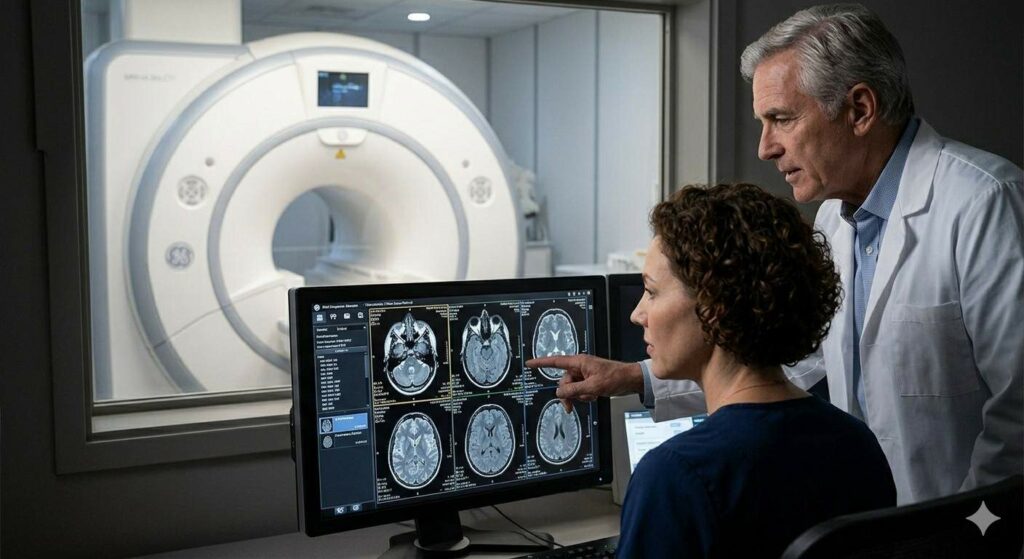
Learn the fastest legit routes into MRI, and how to pick a program that will pass hospital scrutiny. This guide shows what clinical rotations really feel like, plus the exact steps to qualify for ARRT. You will also get a day-by-day workflow preview, and a plan to avoid early-career burnout.
Pick Your Training Route Without Guessing
Most people enter MRI by one of three routes. Each route changes your timeline, cost, and hiring options.
- Radiography first, then MRI: Common in community colleges. You learn X-ray, then cross-train into MRI.
- Primary pathway MRI program: Fewer schools. These focus on MRI from the start.
- Hospital cross-training: You start in imaging, then earn structured MRI competencies while employed.
Before you enroll, ask for three things in writing. Ask for clinical site names, total scan comps, and graduate ARRT pass rates.
ARRT Paperwork You Must Satisfy
The arrt certification requirements for mri are not just a test date. You need eligibility, ethics compliance, and documented education.
- Complete an approved educational path and required MRI content.
- Document clinical experience and procedures. Many programs track this in a competency log.
- Meet ARRT ethics rules. Disclose any prior charges early, even if expunged.
- Apply, pay the exam fee, then schedule at Pearson VUE.
Use ARRT’s exam content outline as your study checklist. Build weekly blocks for safety, anatomy, pulse sequences, and artifacts.
What Clinical Rotations Actually Look Like
People worry about what to expect in mri clinical training. The biggest shift is patient management under strict safety rules.
- Screening: implants, shrapnel risk, medication pumps, and pregnancy questions.
- Room setup: coils, pads, ear protection, and emergency squeeze bulb.
- Protocol work: selecting sequences, planes, and contrast timing with radiologist preferences.
- Workflow: outpatient volume days versus inpatient add-ons and STAT exams.
You will also learn contrast support, often with gadolinium agents. You will not decide medical necessity. You will follow orders and facility policy.
Physics Is Hard, But Predictable
If you are asking how difficult is mri school physics, focus on what is tested. Most courses drill the same pillars.
- Basic magnetism and Larmor frequency concepts.
- RF excitation, relaxation, and signal detection.
- Gradient encoding and k-space basics.
- Pulse sequence families like spin echo and gradient echo.
- Artifacts, SAR limits, and how parameters affect them.
Helpful study tools include MRIQuestions, RadTechBootCamp, and the ARRT MRI content outline. For books, many techs use Westbrook’s MRI text and Lange Q&A style review.
Day-One Reality On The Job
A day in the life of an mri technologist starts before the first patient. You check zone access, crash cart status, and the ferromagnetic detector.
Many sites run Siemens, GE Healthcare, or Philips systems. Others use Canon and Hitachi models, plus dedicated outpatient units from Fujifilm. You will learn vendor menus, then rely on principles.
Most shifts include anxious patients. Expect claustrophobia coaching, positioning adjustments, and occasional motion-reduction tricks like breathing cues.
Pay And Duties: MRI Versus X-Ray
People compare mri tech vs xray tech salary and duties for good reason. Radiography roles often have more portable exams and fluoroscopy exposure. MRI roles lean on safety screening, protocols, and longer exam times.
Pay varies by employer and shift. Newer MRI techs often see offers around $32 to $45 per hour. Experienced techs in high-volume centers can land $45 to $60 per hour. Nights and weekends may add $2 to $8 per hour.
Career Growth That Actually Happens
For mri technologist career path progression, the usual ladder is operational, not academic. You build depth, then widen your modality mix.
- Lead technologist or shift lead.
- Applications specialist for a vendor after strong clinical experience.
- Supervisor or imaging manager with budgeting and staffing duties.
- Multi-modality track into CT, mammography, or interventional support.
Keep a small portfolio. Save protocol changes you helped standardize and any safety audits you contributed to.
Stress, Burnout, And How To Stay Sharp
The challenges of being an mri technologist include safety pressure, time slots, and emotional load. The mri technologist burnout and stress curve spikes in the first year.
- Use a scripted screening flow. It reduces missed questions when you are rushed.
- Build reset time into your day. Even two minutes between patients helps.
- Track near-misses without shame. Treat them as system fixes, not personal failure.
If you are wondering is becoming an mri tech worth it, weigh your tolerance for patient contact and strict safety culture. Many techs love the problem-solving and one-on-one time.
Keep Your Credential Active
The mri technologist continuing education requirements are ongoing. Most credentialing cycles require 24 CE credits every two years. Some techs also complete a structured CE pathway option.
Good CE sources include ASRT, MIC registry prep courses, and vendor education portals. Keep digital copies of certificates. Audits happen.
References
- ARRT
- ASRT
- FDA MRI Safety Communications
Disclaimer: The information provided in this article is for educational and informational purposes only. It does not constitute professional advice. Readers should conduct their own research and consult with qualified professionals before making any decisions.