Hydraulic Car Lifts: Types, Uses, and Safety Tips
Your garage jobs are limited by ground-level access. You may be comparing a scissor platform, a two-post, or a portable setup, and the choices feel risky. This guide is for DIY owners and small shops who want clear lift options, realistic costs, and a safer plan.
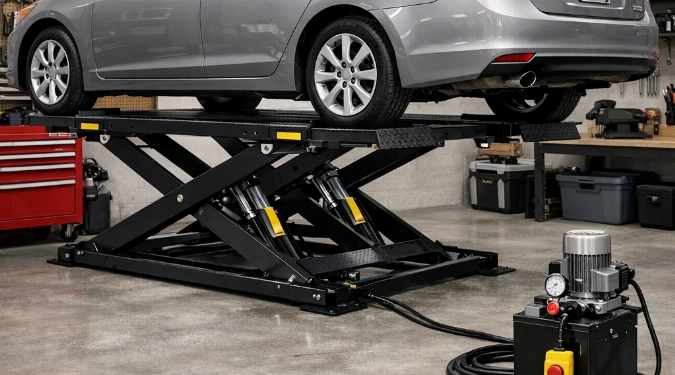
Pick the right hydraulic lift for your garage and your car. Learn what each lift type does best, what it really costs to own, and which specs matter. Use the safety checklist here to spot bad setups, avoid tip-overs, and lift confidently every time.
How Hydraulic Lifts Actually Make Height
Hydraulic systems turn pump pressure into lift force.
A pump moves fluid into a cylinder.
Pressure rises because fluid does not compress.
That pressure pushes a piston upward.
A check valve holds pressure when you stop pumping.
A lowering valve bleeds pressure back to the tank.
Many lifts also use a flow restrictor.
It slows descent if a hose fails.
Four Lift Types You’ll See In Real Garages
Scissor Lift Platforms
A hydraulic scissor lift raises a car on linked arms.
It stores flat and fits low ceilings.
A flat scissor lift is easier to drive onto.
Center-frame styles can block some exhaust work.
Two-Post Lifts
Two-post lifts leave wheels hanging free.
They are great for brakes, suspension, and tires.
They demand strong concrete and careful arm placement.
Four-Post Lifts
Four-post lifts drive on like a rack.
They feel stable and work well for storage.
They need more floor space than other designs.
A rolling bridge jack adds wheel-free work.
Portable Options
A portable scissor lift trades height for convenience.
Some are split-frame and roll on casters.
A portable hydraulic lift is best for quick services.
Expect more setup time and less undercar access.
Choosing By What You Actually Do
Oil changes and detailing favor scissor platforms.
Tire, brake, and suspension jobs favor two-post lifts.
Long-term parking favors four-post lifts.
Transmission work needs clear center access.
For that, avoid center obstructions.
Measure ceiling height to the lowest obstruction.
Measure vehicle height plus lift rise plus pad height.
Also measure door swing clearance.
Specs That Matter More Than Marketing
Capacity should exceed your heaviest vehicle.
Use a real margin, not a close match.
Lift rise controls comfort more than capacity.
Check the minimum lowered height for low cars.
Look for mechanical locks at multiple heights.
Hydraulic pressure should not be the only hold.
Check hose routing and abrasion protection.
Confirm parts support and service manuals.
Brands with strong support include BendPak, Rotary, Mohawk, Challenger, Atlas, and Dannmar.
Power, Outlet, And Pump Details
Some home shops want a 110v scissor lift.
It can work, but duty cycle matters.
Slower pumps run longer and build heat.
Many full-size lifts use 220V motors.
Check motor amperage and breaker needs.
Ask if the power unit is gravity-down.
Gravity-down uses the pump only for up travel.
It reduces heat and simplifies lowering.
Real-World Pricing And Ownership Costs
A new scissor lift price usually runs $2,000 to $5,500.
Full-rise models trend toward the high end.
Two-post lifts often land at $2,800 to $6,500.
Four-post lifts commonly run $3,200 to $8,500.
Shipping can add $300 to $900.
Installation supplies can add $150 to $600.
Concrete work can add $0 to $3,000.
That depends on what you already have.
The scissor lift cost is also pads, fluid, and periodic hoses.
Plan $50 to $250 per year for consumables.
How To Evaluate Used Lifts Before Money Changes Hands
Used units can be a bargain or a trap.
Inspect cylinder rods for pitting and scoring.
Check for wet fittings and seepage at seals.
Listen for pump cavitation or whining.
Confirm locks engage evenly on both sides.
Check bent arms and cracked welds with a light.
Verify all decals and capacity plates exist.
Ask for the manual and parts list.
If you are searching used scissor lifts for sale in area, bring a straightedge.
Use it to spot twisted platforms.
For used scissor lifts, demand a test lift under load.
Safety Habits That Prevent The Ugly Accidents
Use the lift on level concrete only.
Chock wheels when the lift design requires it.
Center the vehicle using manufacturer lift points.
Raise to a few inches and shake-test stability.
Then rise to a lock position.
Set the mechanical locks before going underneath.
Never work under a lift held only by hydraulics.
Keep arms, feet, and cords away from pinch points.
Do not exceed rated capacity, even briefly.
If the lift drifts down, stop using it.
Schedule a seal and valve inspection.
Where People Actually Find Lifts
For a scissor lift for sale, start with manufacturer dealers.
Check auction houses for shop closures.
Look at industrial liquidators and equipment marketplaces.
Local repair shops sometimes sell older units.
Factor rigging costs before you commit.
A cheap unit can be expensive to move.
FAQ
What Fluid Should A Scissor Lift Use?
Use the fluid type listed on the pump tag.
Many power units specify AW-32 or AW-46 hydraulic oil.
Mixing types can swell seals and cause leaks.
What Makes A Lift “Low Profile” In Practice?
It means the collapsed height is small enough for your car.
Also check approach angle and ramp length.
Short ramps can high-center low bumpers.
Can You Add Remote Controls Later?
Some scissor lift hydraulic power units accept aftermarket pendants.
Confirm voltage, contactor rating, and emergency stop wiring.
Do not bypass factory safety circuits.
Disclaimer: The information provided in this article is for educational and informational purposes only. It does not constitute professional advice. Readers should conduct their own research and consult with qualified professionals before making any decisions.