How to Choose the Right Synthetic Oil for Your Engine
Oil shelves are crowded with “full synthetic,” “high mileage,” and confusing spec codes. Pick the wrong one and you can waste money, trigger noises, or miss the protection your engine was designed for. If you want one clear way to choose oil by label facts, this is for you.
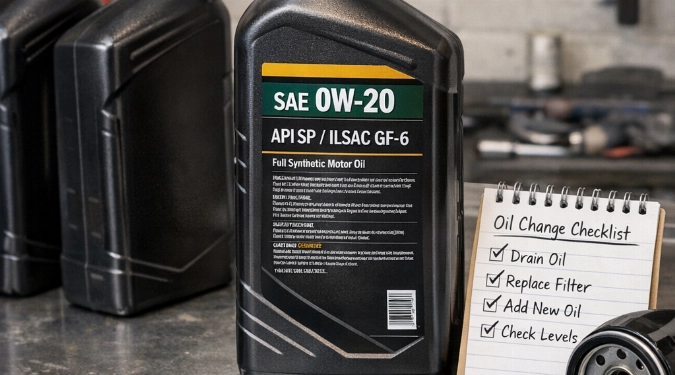
Pick the right viscosity, spec, and additive package for your exact engine. Learn how to read the oil label fast and avoid common marketing traps. This guide ends with a simple checklist you can use at the parts counter or on your next oil change.
Start With The Two Things That Matter
Viscosity Grade
Use the owner’s manual first. Match the SAE grade like 0W-20, 5W-30, or 5W-40. The first number affects cold starts. The second number affects protection at operating temperature.
Required Specification
Modern engines are picky about specs. Look for API SP or ILSAC GF-6 on the label for many gas engines. Some vehicles need an OEM spec too. Examples include dexos1 Gen 3, VW 504 00/507 00, BMW LL-01, and MB 229.5.
How To Read A Bottle In 20 Seconds
Ignore the front label first. Flip to the back. Confirm the viscosity grade. Then confirm the spec line, such as “Meets API SP” or “Meets dexos1 Gen 3.”
Next, check the oil type. Full synthetic usually says “Full Synthetic.” Synthetic blend says “Synthetic Blend” or “Blend.” High mileage oils state a mileage range and seal conditioners.
Full Synthetic Vs Synthetic Blend
Full synthetic handles heat and shear better in most engines. It is a safer choice for turbochargers and direct injection. It can also hold viscosity longer across the interval.
The best synthetic blend oil can still be a solid pick. It often costs less per change. It can work well for older, naturally aspirated engines on shorter intervals.
Typical retail pricing is tight. Synthetic blend often runs $18 to $28 for 5 quarts. Full synthetic often runs $24 to $38 for 5 quarts.
High Mileage Oil: What It Changes
High mileage formulas use seal conditioners and different detergents. They can help reduce seepage on tired seals. They may also tune the additive balance for deposits.
Use it if you have small leaks, higher consumption, or rough startup valvetrain noise. Do not expect it to fix mechanical wear. If your engine is clean and tight, a standard full synthetic is fine.
Many shoppers ask for the best high mileage synthetic oil. The better answer is “the right spec plus a reputable high mileage formula.” Look at Valvoline MaxLife Full Synthetic, Mobil 1 High Mileage, and Pennzoil High Mileage.
Turbo, Direct Injection, And Timing Chains
Turbo engines stress oil with heat. Look for strong specs and a quality filter. Many turbo manuals also call out shorter intervals.
Direct injection can increase fuel dilution. That can thin oil and raise deposits. Oils meeting API SP and GF-6 target this with LSPI protection.
Timing chains like stable viscosity and good anti-wear chemistry. Cheap oils that shear down can accelerate chain wear. Stick to major brands with current specs.
Brand Shortlist That Rarely Lets You Down
If you are asking which synthetic oil is the best, start with brands that consistently meet current specs. Good options include Mobil 1, Pennzoil Platinum, Valvoline Advanced Full Synthetic, Castrol EDGE, Quaker State Full Synthetic, and Royal Purple.
For a single “best synthetic motor oil” answer, the label spec match matters more than the logo. A correct 0W-20 that meets your OEM spec beats a fancy 5W-30 that does not.
If you like synthetic oil rankings, compare on specs and approvals, not “feel.” Look for published approvals like dexos1 Gen 3 or VW 504 00. Treat anecdotal lists as entertainment.
Cars That Usually Require Synthetic
No list of cars that require synthetic oil stays accurate forever. Requirements change by engine code and year. Still, these categories commonly specify full synthetic: turbocharged engines, many hybrids with 0W-16 or 0W-20, and many European-spec engines.
Examples that often call for synthetic include many late-model Ford EcoBoost engines, GM engines that specify dexos, and many BMW and Mercedes engines with OEM approval lists. Always confirm by manual, not trim badge.
A Fast Checklist Before You Pay
- Match SAE viscosity in the manual.
- Match API SP or the exact OEM spec line.
- Choose full synthetic for turbo or long intervals.
- Choose high mileage if you have seepage or consumption.
- Use a quality filter like Wix, PurolatorONE, or OEM.
- Reset the oil life monitor after the change.
FAQ
Is “Meets Requirements” The Same As “Approved”?
No. “Approved” usually means the oil passed the automaker’s tests and is on a list. “Meets” can be self-declared. For strict specs like VW 504 00, approvals matter more.
Can I Switch Back And Forth Between Brands?
Yes, if the viscosity and specs match. Additive packages differ, but they are designed to be compatible. Avoid mixing grades in the same interval unless the manual allows it.
What’s The Best Engine Oil If I Do Short Trips?
Short trips mean more moisture and fuel in the oil. Use a full synthetic that meets the latest spec. Consider shorter intervals, based on your manual and driving pattern.
References
- American Petroleum Institute (API) engine oil categories and licensing marks
- ILSAC GF-6 passenger car engine oil standards
- GM dexos licensing and specifications
Disclaimer: The information provided in this article is for educational and informational purposes only. It does not constitute professional advice. Readers should conduct their own research and consult with qualified professionals before making any decisions.