
Guide to Home Depot HVAC Installation Costs
Home Depot HVAC installation pricing can feel confusing until you see what’s actually being priced: equipment, labor, permits, and home-specific upgrades like duct repairs or electrical changes. This guide explains how Home Depot coordinates installs through vetted local contractors, what the free in-home consultation typically covers (including Manual J sizing), and what common cost line items look like so you can judge your quote on scope—not guesses.
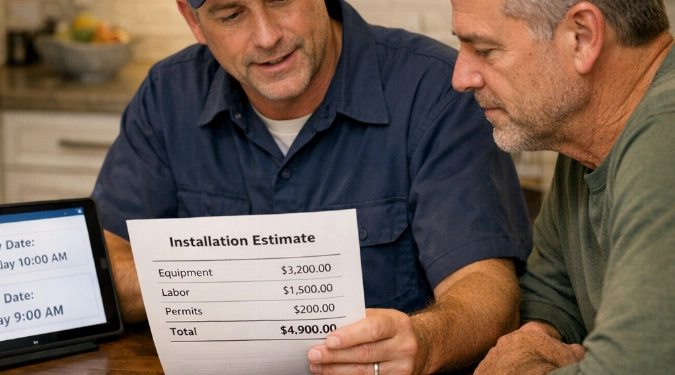
Replacing your heating and cooling is a big spend, so vague ranges don’t help much. This guide explains what typically goes into a Home Depot HVAC quote, what real line items can look like, and how the free in-home consultation and installation timeline usually work—so you can compare options with confidence.
How Home Depot’s HVAC Installation Service Works
With HVAC Home Depot projects, the store typically coordinates the job, while local, licensed, and insured contractors do the field work. In practice, that means one point of scheduling and customer support, paired with a nearby installer who knows local code and permitting.
The process often looks like this: you request information in-store or online, then Home Depot schedules a free in-home consultation. The contractor measures, reviews existing equipment and ducts, and builds an all-in price that includes equipment, labor, and usually haul-away—then you choose whether to proceed.
Typical Home Depot HVAC Installation Cost Ranges
Nationally, Home Depot HVAC costs commonly land in these ranges (equipment plus labor and basic removal). A full system replacement (central AC and furnace) often falls between $7,000 and $15,000. Central AC-only swaps tend to run $4,500 to $8,500, while a gas furnace-only replacement is often $3,500 to $7,500. Heat pumps commonly price out around $5,000 to $12,000 depending on efficiency and electrical needs. These HVAC prices vary because the scope isn’t the same house to house.
What Installation Quotes Often Include
To make the HVAC cost feel real (not just a big number), it helps to understand the typical building blocks that shape the home depot hvac installation cost. Below is a sample of common line items you may see during a cost of new hvac system installed quote—your exact numbers will differ by home and equipment.
| Quote Line Item | What It Covers | Typical Cost Range |
|---|---|---|
| Equipment (Condenser/Coil or Heat Pump) | Outdoor unit and matching indoor coil (or packaged components) | $2,500–$7,500 |
| Equipment (Furnace or Air Handler) | Gas furnace or indoor air handler for heat pump systems | $1,800–$5,500 |
| Labor And Startup | Removal, setting equipment, brazing, evacuation, charging, testing | $1,500–$5,000 |
| Permits And Code Items | Mechanical permit, inspections, code-required updates where needed | $200–$1,200 |
| Electrical Or Gas Modifications | Disconnect, whip, breaker work, gas sediment trap, venting fixes | $300–$2,500 |
| Duct Repairs Or Modifications | Sealing, returns, plenums, resizing, or partial duct replacement | $500–$4,000 |
| Thermostat Upgrade | Optional controls like ecobee or Google Nest (when compatible) | $150–$500 |
These line items are why “HVAC units cost” isn’t the same as total HVAC system cost—installation conditions can swing the final number significantly.
Key Variables That Change Your Final Price
Equipment Brand, Features, And Availability
Home Depot commonly offers systems from brands such as Rheem, Trane, and Carrier (availability varies by market and contractor). Brand tier, communicating technology, and variable-speed components can raise home hvac system costs, but they may improve comfort and humidity control.
System Size And Load Calculation
Proper sizing is based on a load calculation (often referenced as Manual J). Bigger isn’t better—oversizing can short-cycle and reduce dehumidification. Still, larger capacity usually increases hvac system cost because the equipment and sometimes the duct requirements scale up.
Efficiency Ratings That Affect Upfront Pricing
Higher-efficiency equipment typically costs more. For cooling, SEER2 is the common yardstick; for furnaces, AFUE is the efficiency metric. The hvac cost to replace often jumps when moving from minimum efficiency to high-efficiency tiers, especially if venting or electrical upgrades are required.
HVAC Delivery And Scheduling: What To Expect
For many projects, hvac delivery is coordinated so the equipment arrives close to install day (either to the contractor, a distribution point, or directly to the site depending on logistics). Your timeline can stretch if a specific model is backordered, if permits take longer, or if the job needs custom sheet metal.
What Happens During The Free In-Home Consultation
The free in-home consultation is where your contractor can explain why your home depot hvac costs land where they do. Common steps include measuring the home, checking insulation and windows, inspecting ducts and returns, and confirming electrical panel capacity. You’ll typically discuss comfort issues (hot rooms, humidity, noise) and options like zoning or smart thermostats, then receive a written, no-obligation quote.
Cost Scenarios: Replacing Versus Upgrading More Than Equipment
If you’re planning a cost to replace hvac system project, expect a lower total when it’s a straightforward “change-out” with existing ducts in good shape. The cost of new hvac system installed rises when you add ductwork fixes, return-air improvements, panel upgrades, or venting changes. That’s why one neighbor’s hvac cost can be thousands less even with a similar-sized home.
Frequently Asked Questions
What HVAC Brands Does Home Depot Install?
Home Depot commonly works with major manufacturers such as Rheem, Trane, and Carrier through its local installer network. The exact lineup can vary based on regional availability and the contractor’s authorized product lines.
Can I Use My Home Depot Credit Card For An HVAC Installation?
Many homeowners use Home Depot financing options (including the consumer credit card) to spread out the hvac home depot purchase. Promotional terms vary by time and eligibility, so it’s smart to review the offer details listed in your quote paperwork before deciding.
Is The Installation Work Guaranteed?
Coverage is usually layered: a manufacturer parts warranty (often around 10 years with registration), the installing contractor’s labor warranty, and Home Depot’s customer-service support for the project. Ask your contractor to show warranty durations and what’s excluded (for example, drain line clogs or routine maintenance).
Conclusion
A Home Depot HVAC installation cost is best understood as a bundle: equipment, labor, permits, and whatever your home needs to meet code and perform well long-term. Use the free in-home consultation to confirm sizing, efficiency, and any duct or electrical work, then compare the full scope—not just the headline hvac prices—before you decide on your cost to replace HVAC system plan.
Disclaimer: The information provided in this article is for educational and informational purposes only. It does not constitute professional advice. Readers should conduct their own research and consult with qualified professionals before making any decisions.