
Exploring AC Options Without Outdoor Units
Some homes cannot use a standard condenser outside. You might live in a condo, rent, or have strict exterior rules. You still need reliable cooling and maybe heat, without tearing up walls for ducts. This article is for comparing realistic “no outdoor unit” options and avoiding costly mismatches.
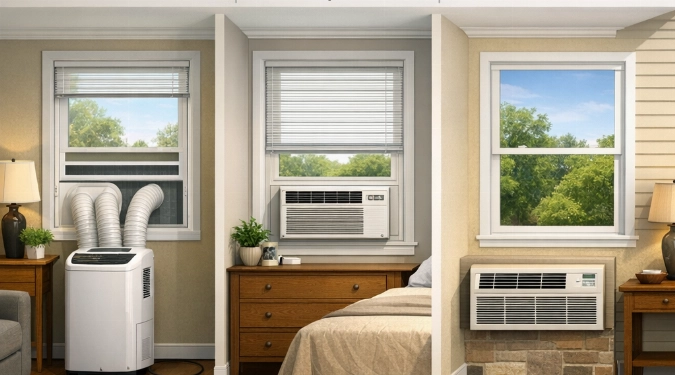
You can cool a room without a big condenser sitting outside. This guide shows the real options that qualify, where each one works best, and what they cost to run. You will finish with a short checklist to pick a model and plan the install.
First, Know What “No Outdoor Unit” Really Means
A true mini-split has an outdoor condenser. So it is not an air conditioner without outdoor units. What people usually want is cooling with no outside box, no pad, and no lineset running outdoors. That narrows the field to a few designs. Some are portable. Some are built into a wall. One type can be installed with only small vents.
Option 1: Dual-Hose Portable AC With A Window Kit
A dual-hose portable unit is the simplest buy-and-try option. It sits indoors and exhausts heat through a window panel. You still need a window or sliding door opening.
Why Dual Hose Matters: Single-hose models pull indoor air out of the room. That can drag hot air in through cracks. Dual-hose units reduce that penalty and usually feel stronger.
What To Look For: Pick a model with an inverter compressor if you want steadier temps. Look for a U-shaped or well-sealed panel for casement windows. Expect louder operation than most fixed systems.
Option 2: Window AC That Also Heats
Some window units include heat pump mode. They can act like single room ac and heating units. They are still “no outdoor unit air conditioner” in the sense that nothing sits outside. Part of the unit does hang outdoors, so check building rules.
Good Fits: Bedrooms, offices, and rentals work well. You can remove it seasonally if needed.
Cold-Weather Limits: Heat pump mode can fade when outdoor air is very cold. Many units switch to electric resistance heat then. That costs more to run per hour.
Option 3: Through-The-Wall AC Sleeves
A through-the-wall unit slides into a metal sleeve. Hotels use these all the time. They avoid taking up a window. They also create a cleaner, more permanent install. Measure the sleeve size before you shop. Common sizes are not universal. Brands like Friedrich, GE, and LG have multiple sleeve standards.
Option 4: PTAC And PTHP Hotel-Style Units
PTAC units cool. PTHP units cool and heat. They sit in a wall sleeve with a grille outside. No separate condenser sits outdoors. These are tough and serviceable. They are also louder than most modern split systems. They can be a smart choice for workshops or additions.
Option 5: “Ductless” Systems That Hide The Outdoor Side
Some people ask for a ductless air conditioner, but they really mean “no visible outside unit.” A standard mini-split still needs one. There are niche products that use two small wall penetrations instead. Examples include Unico’s small-duct systems and a few monobloc heat pumps. Availability varies by contractor. If you truly need ductless heating and cooling systems cost numbers, treat these as premium installs. Plan for higher labor and limited service options.
Energy Use And What It Costs To Run
Energy efficient cooling depends more on fit and sealing than brand labels. A portable unit in a leaky room will burn power. A tight room with a right-sized unit will feel better and cost less. Use a simple sizing check. A rough starting point is 20 BTU per square foot. Add capacity for strong sun, high ceilings, or lots of people. Avoid oversizing because it can short-cycle and leave humidity behind.
How To Avoid A Bad Fit
For ductless air conditioner where to buy questions, start by deciding if you need a contractor. Portable and window units are retail friendly. Through-the-wall and PTAC units often need careful measurements. Check three things before you order. Match the electrical plug and amperage to the outlet. Confirm window type or sleeve dimensions. Confirm condensate handling, since some units evaporate it and others drain. If you see ductless air conditioners for sale in marketplaces, verify the model is new and complete. Missing window kits and sleeves are common.
Decision Checklist
- No window access: consider through-the-wall or PTAC.
- Strict exterior rules: start with portable, then ask about monobloc options.
- Need heat too: prioritize window heat pump or PTHP.
- Noise sensitivity: avoid PTAC, and look for inverter window units.
- Long-term plan: choose the most permanent install you can maintain.
FAQs
Can A Heat Pump Work Without An Outdoor Box?
Some heat pump systems are monobloc designs. They keep the refrigerant circuit indoors. They still need two wall openings for intake and exhaust air.
Do “Indoor-Only” Units Still Need Venting?
Yes, if they move heat out of the room. A portable uses a hose. A wall unit uses an exterior grille. An indoor unit air conditioner that is truly sealed would not be able to cool.
Will A Portable AC Trigger Smoke Or CO Alarms?
It should not, if installed correctly. The main risk is a loose exhaust connection. Keep the hose short and the window panel sealed.
References
- ENERGY STAR: Room Air Conditioners and Portable Air Conditioners guidance
- AHRI: Performance certification directories for HVAC equipment
- DOE: Consumer resources on heating and cooling efficiency
Disclaimer: The information provided in this article is for educational and informational purposes only. It does not constitute professional advice. Readers should conduct their own research and consult with qualified professionals before making any decisions.