
Dermatitis Relief: Helpful Treatments to Know
Dermatitis flares can hijack sleep, focus, and confidence. You may have tried creams that burn, steroids that rebound, or routines that never stick. This guide breaks down what helps by severity, which products are worth paying for, and what questions to bring to a clinician so you stop guessing.
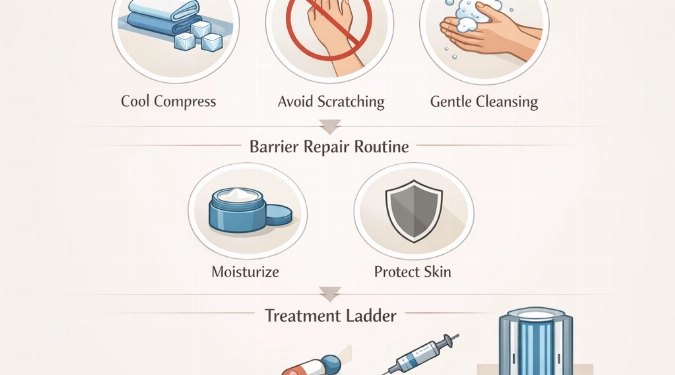
Know what to do in the next 10 minutes, the next 10 days, and the next doctor visit. You will learn how to stop the itch cycle, pick products that do not sting, and use meds safely. You will also know when a rash needs urgent care and when to ask about stronger options.
Start With The Itch Cycle, Not The Rash
Scratching creates micro-tears. Those tears let in irritants and bacteria. That drives more inflammation and more itch.
Fast Itch Interrupts
- Cool compress for 5 to 10 minutes. Use a damp washcloth, not ice on skin.
- Wet wrap for hands or feet. Apply ointment, then a damp layer, then a dry layer for 30 to 60 minutes.
- Short nails plus cotton gloves at night. This cuts damage when you scratch in sleep.
- Pramoxine lotion for spot itch. Many people tolerate it better than menthol.
Baseline Routine That Usually Wins
This routine fits most eczema and irritant dermatitis patterns. It also helps while you wait for prescriptions to work.
- Shower brief and lukewarm. Aim for under 10 minutes.
- Use a fragrance-free cleanser only where needed. Try Vanicream Gentle Body Wash, CeraVe Hydrating Cleanser, or Dove Sensitive Skin.
- Pat dry, then moisturize within 3 minutes. This locks in water.
- Choose an ointment for flares. Petrolatum, Aquaphor Healing Ointment, and CeraVe Healing Ointment are common picks.
- Use cream for daytime if ointment feels greasy. Try Eucerin Advanced Repair Cream or La Roche-Posay Lipikar Balm AP+.
If you wonder How to Get Rid of Eczema Itching, this is the highest return starting point. It reduces triggers while you address inflammation.
Trigger Checks You Can Do This Week
Do not change ten things at once. Change one variable for seven days. Track itch, sleep, and new spots.
- Switch laundry to free-and-clear. Skip scent beads and dryer sheets.
- Pause new skin care, candles, and essential oils. Fragrance is a common irritant.
- Check hands. Dish soap, sanitizer, and wet work drive flares.
- Look at clothing. Wool and rough seams cause friction itch.
- Consider nickel or rubber contact. Watch for belt buckles, watch backs, and gloves.
Over-The-Counter Options With A Clear Role
OTC products work best when you match them to the job. Do not stack five “actives” on angry skin.
- Hydrocortisone 1%: short-term anti-inflammatory for mild flares. Avoid long use on thin skin unless guided.
- Colloidal oatmeal: soothing bath or lotion. It can reduce sting during flares.
- Ceramides: barrier lipids in many moisturizers. CeraVe and Cetaphil Restoraderm include them.
- Dimethicone: protective film for irritant exposure. Useful for hand dermatitis.
- Bleach baths: sometimes used for recurrent infected eczema. Do this only with clinician instructions.
Prescription Paths Your Clinician May Offer
Topical corticosteroids are commonly used to reduce inflammation during flares. Potency, location, and duration matter, so ask about the right strength for different body areas and how long to use it.
Calcineurin inhibitors are non‑steroidal topicals that can be helpful on sensitive areas such as the face or skin folds.
Antihistamines may ease nighttime itch and help you sleep when symptoms are distracting. They do not treat the underlying inflammation but can be a short‑term support while other therapies do the heavy lifting.
Antifungals are useful when yeast plays a role, such as in some seborrheic dermatitis scenarios.
Antibiotics can be considered when dermatitis becomes secondarily infected, which can present with honey‑colored crusts, warmth, or pain.
This is the core of Dermatitis Treatments and Medication Options. Your best match depends on location, severity, and past response.
Biologics And Targeted Pills For Moderate To Severe Disease
- Biologics for Dermatitis: dupilumab and tralokinumab are injections that target specific immune signals. They can reduce flares and steroid need.
- Targeted oral JAK inhibitors: options include Rinvoq Treatment and abrocitinib. These can work quickly for itch in some patients.
If you are searching How to Get Rid of Eczema Fast, ask about a bridge plan. Many clinicians pair a short burst topical plan with a longer-term controller.
When A Rash Needs Urgent Care
- Fever, rapidly spreading redness, or severe pain.
- Honey-colored crusts, pus, or worsening oozing.
- Eye involvement, facial swelling, or trouble breathing.
- Blistering after a new medicine or skin product.
FAQ
Is “Agzima Medicine” A Known Dermatitis Drug?
The name does not match common dermatitis prescriptions. Ask for the generic name, the drug class, and the exact label. Bring the bottle or a photo to your visit.
Should I Rotate Moisturizers?
Rotate only if one stings or breaks you out. Consistency matters more than variety. Keep one ointment and one cream that you tolerate.
Does Diet Fix Dermatitis?
Diet changes help a subset of people. Do not do broad eliminations without guidance. If food allergy is suspected, ask about formal testing.
References
- American Academy of Dermatology: Atopic dermatitis and contact dermatitis care guidance
- National Eczema Association: Moisturizing, wet wraps, and trigger management
- FDA prescribing information for dupilumab, tralokinumab, upadacitinib, abrocitinib, and ruxolitinib cream
Disclaimer: The information provided in this article is for educational and informational purposes only. It does not constitute professional advice. Readers should conduct their own research and consult with qualified professionals before making any decisions.