
AI Influencer Marketing Strategies to Explore
Curious how to use AI influencers without losing trust or wasting budget? This article breaks down AI influencer marketing strategies you can realistically explore, including how to define a virtual persona’s role, choose a production approach, build repeatable content series, run clean A/B tests, and set disclosure and brand-safety rules. You’ll also get a practical performance table and FAQs to help plan, measure, and scale campaigns with confidence.
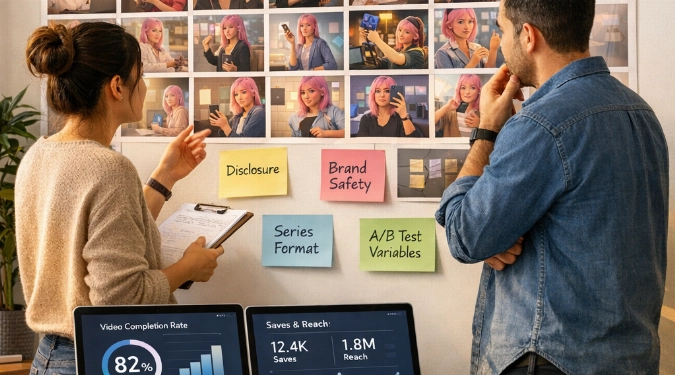
AI influencers can move faster than traditional creator rosters, but only if your strategy is built for trust, disclosure, and repeatable production. Below are practical AI influencer marketing strategies to explore, from concept testing to long-term ambassador programs, with the guardrails that keep campaigns brand-safe.
Start With A Clear Role For The AI Influencer
Before you design assets, decide what the character is responsible for: awareness, education, conversion support, or community building. The best results usually come when the AI persona has a single lane, like “product explainer” or “style curator,” instead of trying to do everything at once.
When positioning AI brand ambassadors, document voice rules, visual boundaries, and what the influencer will never say. This makes approvals faster and prevents tone drift when multiple teams create content.
Pick The Right Build Approach For Your Timeline
Your production method affects cost, speed, and realism. Some brands use simple 2D/3D characters for fast social content, while others invest in higher-fidelity models for ongoing campaigns.
Three Common Production Setups
- CGI character + human-managed socials: reliable for consistent posting cadence and controlled brand voice.
- Hybrid pipeline: a CGI base plus AI-assisted scripting, storyboards, and localization for quicker iteration.
- Full virtual production: higher-end scenes, product shots, and motion capture for premium launches and evergreen content.
For CGI influencer marketing, align early on whether realism is a goal. Sometimes a stylized look performs better because it signals “fictional” clearly, which may reduce confusion.
Design Content Series Instead Of One-Off Posts
AI generated influencers tend to perform best when audiences can predict the format. Build series like weekly “how it works,” seasonal trend rundowns, or behind-the-scenes of product testing (without implying the AI used the product). A series makes it easier to measure creative changes because your structure stays constant.
Keep a content matrix with 3 to 5 repeatable pillars: education, lifestyle integration, UGC-style prompts, creator collabs, and product comparisons. This supports consistent digital influencer campaigns without creative burnout.
Run Fast A/B Tests With Versioned Creative
One advantage of synthetic characters is controlled experimentation. Test one variable at a time: hook line, scene length, background color, wardrobe, or CTA phrasing. Track performance by platform-native metrics like 3-second views, saves, and hold rate, not just likes.
To stay grounded, set a test window (for example, seven to fourteen days) and a minimum impression threshold before declaring a “winner.” This keeps synthetic influencer advertising from chasing noise.
Build Trust With Transparent Disclosures And Brand Safety Rules
Make disclosures easy to spot in captions and on-screen text, and keep them consistent across platforms. Also define rules for sensitive topics, prohibited claims, and how you handle comments that assume the influencer is human.
In the United States, the FTC’s Endorsement Guides expect clear disclosure when content is sponsored or when there is a material connection. If the influencer is virtual, clarity matters even more. Treat your disclosure approach as part of the creative, not a legal afterthought.
Use Licensing And IP Strategy To Avoid Future Rework
Clarify ownership of the character model, name, voice, and wardrobe elements, especially if you use outside studios or stock assets. If you plan to scale into ads, negotiate usage across paid social, connected TV, out-of-home, and retail media at the start.
For virtual influencer marketing, it also helps to define “canon”: backstory, personality traits, and brand partnerships the character will or will not take. Canon reduces continuity errors that audiences notice quickly.
Activate Across Paid, Owned, And Retail Media
Many teams stop at organic posts. Instead, adapt the same creative into short paid cuts, product page video, email headers, and in-store display loops. This is where consistency can compound because the character’s look and voice stay uniform.
If you use platforms like TikTok, Instagram, and YouTube, build platform-specific edits rather than resizing one master. Small changes like caption density and pacing can materially affect watch time.
Measure What Matters With A Simple Performance Table
| Goal | Primary Metric | Practical Signal To Watch |
|---|---|---|
| Awareness | Reach and video completion | Higher completion often indicates the concept is clear |
| Consideration | Saves, shares, site clicks | Saves can indicate “future intent” more than likes |
| Conversion Support | Assisted conversions | Lift in branded search and product page time-on-page |
FAQ
Are AI Influencers Allowed To Do Sponsored Content?
Typically yes, but sponsorships should be disclosed clearly and consistently. Follow FTC disclosure principles, and ensure the creative does not imply experiences or attributes that are untrue or unverified.
What Types Of Brands Benefit Most From Virtual Influencers?
Brands with frequent launches or complex education needs often benefit, including beauty, fashion, food, and consumer tech. The advantage is repeatable production and consistent messaging, not “replacing” human creators.
How Do You Keep A Synthetic Influencer From Feeling Inauthentic?
Use a stable series format, a well-defined voice, and transparent disclosure. Pair the AI character with real customer stories, product demos, and creator collaborations so the campaign is rooted in reality.
Can AI Influencers Replace Human Creators?
They usually work best as a complement. Human creators bring lived experience and community credibility, while virtual characters can provide consistent brand storytelling and rapid iteration.
Conclusion
Exploring AI influencer marketing strategies is less about novelty and more about operational clarity: define the AI influencer’s role, choose a build approach you can sustain, run structured tests, disclose transparently, and measure performance against specific goals. With those pieces in place, synthetic characters can become a repeatable, brand-safe part of your marketing mix.
Disclaimer: The information provided in this article is for educational and informational purposes only. It does not constitute professional advice. Readers should conduct their own research and consult with qualified professionals before making any decisions.