
A Guide to How Electric Car Engineering Works
Electric cars can feel like a black box: big battery, silent motor, and lots of software in between. If you’re shopping, studying, or building a small EV, you need a clear picture of what each major part does. This article breaks down the system so you can ask better questions and avoid hype.
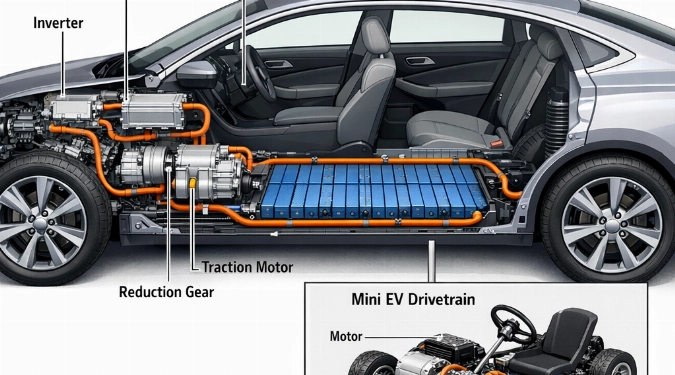
See how electricity turns into motion in a modern EV. You’ll map the power path from battery cells to the wheels. You’ll learn what key parts do, and what usually fails first. You’ll also get a simple plan to study, test, and build a tiny EV project.
The Simple Map: From Plug To Pavement
An electric car is a chain of energy conversions. It starts as stored energy in a battery. It ends as turning force at the tires.
Here is the common path in plain terms.
- Battery pack stores DC electricity.
- Inverter turns DC into three-phase AC for the motor.
- Motor turns electrical power into rotation.
- Gear reduction trades motor speed for wheel torque.
- Wheels push the car forward.
When you brake, the path can run backward. The motor becomes a generator. That energy goes back into the pack as regenerative braking.
What Powers An Electric Car
Most drivers never see the core parts. Engineers think about them every day.
The heart is the battery pack. The “brain” is the power electronics and control software. The “muscle” is the traction motor.
Electric Engine Components You Should Know
People still say “engine” out of habit. EVs use motors, not combustion engines. The Electric Engine Components that matter in a traction motor are simple to name.
- Stator: stationary coils that create a rotating magnetic field.
- Rotor: spinning part that follows that field.
- Position sensors or estimators: they time the current for smooth torque.
- Bearings: they carry loads and often limit long-term durability.
The inverter is the translator between pack and motor. It switches transistors fast to shape AC current. Many newer designs use silicon carbide devices for lower losses.
Other supporting parts do unglamorous work. The onboard charger handles AC charging. A DC fast charge path feeds the pack more directly. A DC/DC converter steps pack voltage down for 12-volt systems.
Battery Pack Management That Saves The Pack
A battery pack is many cells in series and parallel. Small differences between cells grow over time. That is why the battery management system matters.
A BMS watches cell voltage, current, and temperature. It can balance cells so one weak cell does not cap the whole pack. It also enforces safety limits during charge and discharge.
Thermal management is the BMS’s best friend. Coolant channels, cold plates, and heat exchangers keep parts in their safe window. Software decides when to cool, heat, or limit power.
Drivetrain Choices Engineers Actually Debate
EV engineering is full of tradeoffs. Most of them come down to heat, cost, and efficiency.
- Motor type: permanent magnet, induction, or switched reluctance.
- Pack voltage: many designs sit around 400 volts or 800 volts.
- Single-speed vs multi-speed gearboxes.
- Cooling strategy: shared loops or separate loops.
Real-world examples help anchor this. Tesla uses permanent magnet and induction variants across models. Lucid leans into high-voltage design and tight efficiency. Rivian targets high torque for trucks. Ford, GM, and Hyundai each balance cost and serviceability differently.
A Quick Diagnostic Mindset For EV Problems
EV troubleshooting starts with the energy chain. Ask where energy stops flowing. Then ask why the system decided to limit power.
Common “feels like” symptoms often have simple buckets.
- Sudden power limit: heat, low state of charge, or a sensor fault.
- Reduced range: cold weather, tire issues, or battery aging.
- Charging trouble: station handshake, onboard charger faults, or pack temperature limits.
Engineers confirm with data. They look at temperatures, voltages, and current. They also check fault codes over the vehicle network bus.
Study Paths That Translate Into Real Skill
If you want formal study, look for Electric Vehicle Engineering Courses that include lab time. A lecture-only plan leaves big gaps. Power electronics and embedded controls are where many learners stumble.
An Electric Car Engineering Degree is usually electrical engineering, mechanical engineering, or mechatronics with EV electives. Prioritize circuits, control systems, electric machines, and thermal design. Add battery safety, instrumentation, and test methods.
Programs and resources often used by serious learners include MIT OpenCourseWare for electric machines, SAE learning modules, and university EV capstone teams. Use each course to build a small artifact. That can be a test report, a controller demo, or a thermal model.
Start Small With A Mini EV Build
A small build teaches the whole system fast. A go-kart scale platform is enough. This is where an Electric Mini Car project earns its keep.
Keep the first version boring and safe. Use a brushless DC motor, a matched ESC, and a lithium pack with a proper BMS. Add a main fuse, a contactor, and an emergency stop.
If your goal is a Mini Electric Car for Adults, treat safety like a real vehicle. Add mechanical brakes that work without regen. Use proper cable lugs and strain relief. Enclose the pack and label service disconnects.
A useful “learning rig” is not a toy. A Mini Car Electric setup should let you measure current, motor temperature, and pack sag under load. Log the data and write down what changed between tests.
What To Do Next
- Pick one subsystem to focus on for 30 days.
- Draw a block diagram of your target EV platform.
- Learn to read basic motor and inverter specs.
- Build a small test stand and log real measurements.
- Write one clear test report with plots and conclusions.
FAQs
Why Do EVs Often Use A Single-Speed Gear?
Electric motors make useful torque across a wide speed band. A fixed reduction gear is often enough. It also cuts cost and improves reliability.
What Makes Fast Charging Hard On Batteries?
High current creates heat and stresses cell chemistry. The BMS may slow charging if the pack is cold or hot. Good thermal design protects the pack and keeps charge times consistent.
What Tools Do EV Engineers Use Day To Day?
Many use MATLAB and Simulink for controls work. Others use LTspice for power stages and Altium for PCB design. For mechanical and thermal work, common tools include ANSYS and SolidWorks.
Disclaimer: The information provided in this article is for educational and informational purposes only. It does not constitute professional advice. Readers should conduct their own research and consult with qualified professionals before making any decisions.