
10 Bewildering Photos That Are Not Quite What They Seem
Visual history is filled with illusions that constantly challenge our perception of reality. When we look closely at the 10 bewildering photos that are not quite what they seem, we often find that lighting, camera angles, and early darkroom techniques created highly convincing mysteries. By examining these photos that are not what they seem explained, you can better understand how photographic anomalies occur. Let us review exactly 10 bewildering photos that are not quite what they seem and uncover the truth behind them.
1. The Solway Firth Spaceman
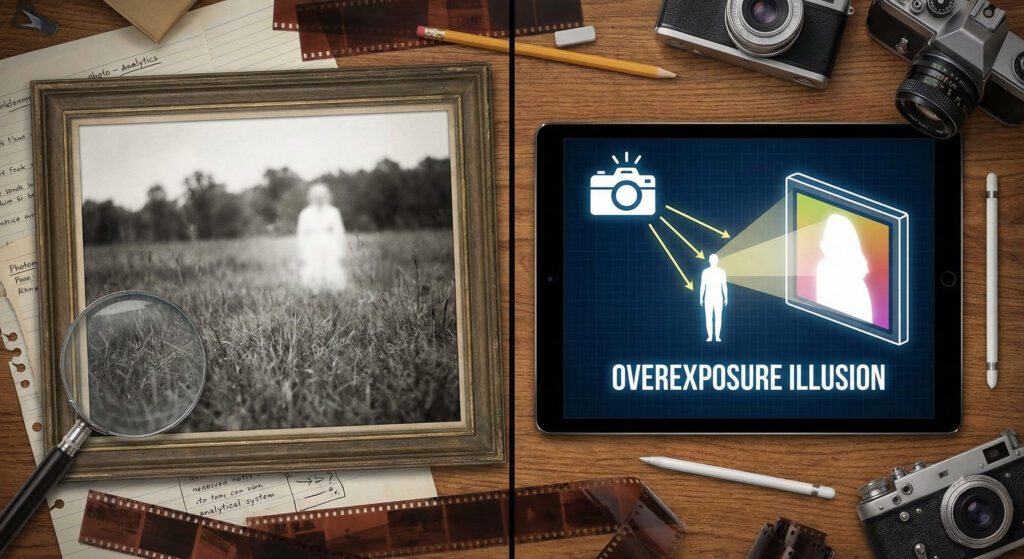
In 1964, a photographer took a picture of his young daughter in a grassy field, only to find what appeared to be an astronaut standing behind her. This image often tops lists of unsettling photos explained. The white “spacesuit” was actually the photographer’s wife, standing with her back to the camera. Her light blue dress became severely overexposed in the bright sunlight, creating an optical illusion that completely obscured her normal appearance.
2. The Cottingley Fairies
In 1917, two cousins produced images appearing to show them interacting with tiny winged figures in their garden. These serve as prime examples of confusing historical photos explained. The girls used flat paper cutouts of dancing figures copied from a popular children’s book, supporting them with long hatpins stuck into the foliage. The camera’s soft focus and the natural outdoor setting helped obscure the flat nature of the paper.
3. The 1941 Time Traveler
A photograph taken at a Canadian bridge reopening in 1941 shows a large crowd of people, but one man stands out, appearing to wear modern wraparound sunglasses and a printed t-shirt. When seeking weird photos with explanations, this image frequently appears. Historical research reveals that his attire was entirely accurate for the era. The sunglasses were a specialized style featuring protective side shields commonly worn by welders, and the “t-shirt” was a standard knitted sweater worn by local sports teams.
4. The Hook Island Sea Monster
In 1964, an image surfaced showing a massive, tadpole-like creature resting in the shallow waters of a lagoon. Providing strange photos with context helps clarify what viewers actually saw. The “monster” was a large sheet of dark plastic weighted down with sand. The photographer used specific angles and the water’s natural distortion to make the flat plastic appear three-dimensional and lifelike.
5. The Surgeon’s Photograph of the Loch Ness Monster
Perhaps the most famous monster picture ever taken, this 1934 image shows a long neck extending from dark water. When examining bizarre real life images explained, this is a classic example of a physical prop. Decades later, participants revealed that the “monster” was simply a toy submarine outfitted with a sculpted head and neck made from plastic wood. The tight cropping of the image made the small ripples look like large, crashing waves.
6. The Cooper Family Falling Body
A widely shared internet image shows a family posing at a dining table while a blurry body appears to hang upside down from the ceiling. Learning the viral strange photos full story removes the mystery entirely. This effect typically happens due to double exposure, where a segment of previously exposed film is accidentally exposed again. The falling figure was likely an upside-down photograph of a person from a completely different roll of film, superimposed over the family portrait.
7. The Babushka Lady of 1963
During the events in Dallas in 1963, a woman in a headscarf was photographed holding what looked like a camera, remaining unusually calm while others panicked. For years, she was the subject of intense speculation. However, analyzing confusing photos explained by historians shows that the camera angle drastically compressed the scene. She was standing further back than initially thought, and her posture was a typical reaction of confusion rather than cold calculation.
8. The Skunk Ape of Florida
In 2000, two photographs were mailed to a Florida sheriff’s department showing a large, hairy creature hiding behind palmetto leaves. While it looked intimidating, wildlife experts provided clear context. The creature was identified as an escaped orangutan hiding in the brush. The combination of heavy shadows, the flash of the camera, and the unusual environment made the standard primate look entirely alien.
9. The Face on Mars
In 1976, the Viking 1 spacecraft captured an image of a Martian mesa that looked remarkably like a human face. This sparked decades of theories about alien monuments. Modern satellite imagery provides the ultimate resolution. The “face” was purely the result of pareidolia—the human tendency to see faces in random patterns—combined with low image resolution and the specific angle of the sun casting shadows across natural rock formations.
10. The Ghost of Newby Church
A 1953 photograph taken inside a church in North Yorkshire appears to show a towering, translucent figure wearing a cowl. Like many anomalies from that era, this is an excellent study in photographic mechanics. The anomaly was caused by a double exposure or a long exposure where a person briefly walked into the frame and stood still before moving out of the shot, leaving a faint, ghostly imprint on the negative.
Frequently Asked Questions
Why do so many unsettling photos turn out to be simple camera errors? Early film cameras often required manual advancement of the film. If a user forgot to wind the film forward, the next picture would be taken directly over the previous one, creating a double exposure. This mechanical quirk is responsible for many vintage images that appear to show transparent figures or impossible overlaps.
How can you tell if vintage images feature double exposures? You can often identify double exposures by looking for consistent transparency across the “ghostly” figure and the background. If the background texture is perfectly visible through the anomaly without any physical disruption to the surrounding light, the image is typically a double exposure rather than a physical object present in the room.
Are modern viral strange photos easier to debunk? Modern digital images leave behind metadata and pixel patterns that experts can analyze. While digital editing software makes it easier to create anomalies, advanced forensic tools also make it much simpler to detect manipulation, color alteration, and digital splicing.
Conclusion
Examining exactly 10 bewildering photos that are not quite what they seem highlights how easily the human eye can be tricked by light, perspective, and mechanical camera errors. By exploring the real context behind these specific images, we demystify history and learn to approach extraordinary visual claims with a logical perspective. Understanding these 10 bewildering photos that are not quite what they seem encourages us to seek facts over immediate assumptions when evaluating strange visual media.
Disclaimer: The information provided in this article is for educational and informational purposes only. It does not constitute professional advice. Readers should conduct their own research and consult with qualified professionals before making any decisions.